|
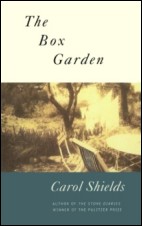
The Box Garden
1977
Until events run wildly out
of hand, Charleen Forrest manages to cope with the uncertainties
of a failed marriage, trying to live her own life and raise
a son on her frugal income. She is not unaware of the hazards:
"family, banktellers, ex-husband, landladies, from bus drivers
who tell her to move along, men on the make who want her
to lie back and accept (this is what you need, baby), friends
who feel sorry for her." Her resourcefulness is a delight;
her uncanny observations and surprising irony reveal a witty,
wry edge that is apt to make you laugh out loud.
Small Ceremonies and The Box Garden were published
together as Duet in the UK
in 2003.
 Buy
the Book Buy
the Book
Click
here to order.
 |
A shrewd and
skillful storyteller."
- Chicago Tribune
|
|
Her sentences and subjects swerve
in a matter of words from the poetic to the colloquial,
uniting the dazzling and the ordinary, the domestic
and the cosmic."
-Joan Barfoot,
London Free Press
|
Read
an Excerpt
Click
here to read excerpt.
|
[Shields] has a lot going for her: wit, perception and
a gentle irony; an impeccable and uncanny ear for dialogue;
and best of all, a sense of language that comes as easily
as breathing."
- Saturday Night
|
|
The Box Garden is
fun, it is lively, it has intelligence...What makes
[Carol Shields] special, apart from her slashing wit,
her generosity and her insight into the extraordinariness
of ordinary life, is her formal inventiveness, at once
modest and daring, like a Modernist seamstress."
- Amanda Craig,
Literary Review
|
Summary
Charleen Forrest's husband
has left her. Gone, not only from her own life, but apparently
off the face of the earth. Charleen is left with his name
and their marvellously uncomplicated son, Seth. She also
has a fair talent for poetry, and a job on The National
Botanical Journal which brings her in touch with the mysterious
Brother Adam - a man with a contagious passion for silence
and grass.
The Box Garden celebrates
Charleen's resourcefulness, creativity and tenacity in
the face of little money and few resources. Her piercing
gifts of observation are wonderfully balanced with her
intermittent bouts of all-too-familiar feelings of incompetence
that are as tenderly observed as her gifts for love and
survival.
- back cover of the 1977 print version
|
The novel's protagonist, Charleen
Forrest, is an appealing combination of common sense
and irrepressible idealism, qualities which her status
as a single mother and low-paid wage earner put to frequent
test. Shields doesn't exaggerate or sentimentalize these
difficulties, but simply describes them in straightforward,
low-key prose that brings us to the vital center of
Charleen's emotional life."
- Toronto Star
|
|
Charleen not only endures but comes
out stronger after one especially trying weeklong trip
across Canada to attend her mother's wedding when she
is confronted with more of her past than she, or the
reader, expects. It's the sort of experience that should
send her completely over the edge, but Charleen isn't
quite as fragile as she seems. In less capable hands
she'd be a caricature, her transformation contrived.
But Shields makes Charleen and her experiences believable.
Even more rewarding, she makes them endearing."
- Publisher's
Weekly
|
|
A distinctly darker novel than its
companion, trapped uneasily between farce and something
more sinister, ''The Box Garden'' serves above all as
an enlightening expansion of the dynamics of the McNinn
family. It draws a memorable portrait of a bitter mother
and her daughters, and ultimately grants both Mrs. McNinn
and Charleen the prospect of happiness." (Click
here
to read entire review.)
-
Claire Messud, New York Times
|
|