|
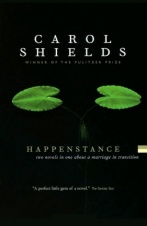
Happenstance: two novels in one
about a marriage in transition
1994
These two unique companion
novels tell the stories of Jack and Brenda Bowman during
a rare time apart in their many years of marriage. In The
Husband's Story (originally published in 1980 as Happenstance),
Jack is at home coping with domestic crises and two uncouth
adolescents while immobilized by self-doubt and questioning
his worth as a historian. In The Wife's Story (originally
published in 1982 as A Fairly Conventional Woman),
Brenda, traveling alone for the first time, is in a strange
city grappling with an array of emotions and toying with
the idea of an affair. Intimate, insightful and never sentimental,
Happenstance is a profound portrait of a marriage
and of those differences between the sexes that brings life
- and a sense of isolation - into the most loving relationships.
 Buy
the Book Buy
the Book
Click
here to order
 |
A perfect little gem of a novel."
- Toronto Star
|
Read
an Excerpt
Click
here to read excerpt.
Review
This book has the unusual format
of containing two books in one: from front to back reads
"The Wife's story" and from back to front "The Husband's
story." The latter was written first, but the two are
written such that either can be read first.
The wife, Brenda Bowman, is a housewife
who has recently gained commercial success and cultural
renown as a quiltmaker. As the novel opens, she is leaving
her Chicago home to attend a quiltmaker's conference in
Philadelphia. Over the course of a week, she attends workshops
on various aspects of quiltmaking, makes friends, and
becomes increasingly intimate with a man she meets. On
the first night at the conference, she visits him in his
room and leaves there her brand new red raincoat, which
she purchased at an exorbitant price, and finds it missing
when she returns. She reflects much on her relationship
with her husband Jack and with the two teenage children
she has left at home.
Meanwhile, Jack remains at home.
His half of the story covers the same timespan but essentially
none of the same events. Jack is a historian who has been
working for years at the same book and is beginning to
doubt himself and his subject matter. He reads in a journal
that an ex-girlfriend, the girl he left for Brenda, has
just published a book on ostensibly the same topic. While
pondering the future of his career, Jack is overwhelmed
by crises: his best friend separates from his wife and
comes to stay at the Bowman house; the next door neighbor
attempts suicide. All the while, Jack ponders his own
role in history and the way that the recorded versions
of events often leave out the most significant points.
- Melissa Rachiele, Resident Scholar, allreaders.com
|
As Shields handily demonstrates
here, a marriage is the culmination of a million tiny
moments, and she strings them together with intense
cumulative power....a tour de force."
- Publishers
Weekly
|
|
Carol Shields writes with delicacy
and perception."
- The Montreal
Gazette
|
Interview
Interview with Carol Shields
about Happenstance (The Husband's Story)
Winnipeg Radio 2, 1981
Transcription of audio tape
| Int |
Carol
Shields is a Winnipeg writer. Her latest book is called
Happenstance, a novel about a middle-aged survivor.
I talked with Carol about her interesting views on
being an author.
Carol, I'd like to begin by asking you about the title
of your novel Happenstance. You have a quote
in there about the hero, Jack Bowman, and it is
pure happenstance that made him into a man without
serious impairment or unspeakable losses and explain
the significance of that. |
| CS |
Well happenstance
is a strange word. It means half chance, half circumstance
I think. I think really most of us are the people
we are by chance. We don't write our own script I
suppose is what I'm saying. We can't really blame
all the forces around us - our parents and our happy
or unhappy childhood - for the way we turn out. I
think it's all a matter of chance or happenstance. |
 |
Review
Re Marriage
Carol Shields (Author)
Happenstance: Two Novels in One About a Marriage in
Transition.
Reviewed by Donna Coates
In a recent interview, Carol Shields
confessed that she was "furious" when she came out of
Four Weddings and a Funeral because "absolutely no
one in that film had a job. People's work lives are written
out of novels, too." Shields never writes people's work
lives out of her fiction, though; in Happenstance
(1980) and A Fairly Conventional Woman (1982),
re-issued as the two-volume set Happenstance: Two Novels
in One About a Marriage in Transition (1991, 1994,
1997) work is a (pre)-occupation, one which she has continued
to explore in The Stone Diaries (1993) and Larry's
Party (1997). The clever packaging of Happenstance,
apparently Shields' idea-the novels open from opposite
sides, each upside down to the other-reflects her belief
that the cultural conditioning imposed upon women and
men in the 1950s which encouraged them to value work differently
was detrimental to both.
|